
Publisher:
Bonnie King
CONTACT:
Newsroom@Salem-news.com
Advertising:
Adsales@Salem-news.com
~Truth~
~Justice~
~Peace~
TJP
Feb-06-2008 10:20

 TweetFollow @OregonNews
UN Survey Reveals that Afghan Opium Production Remains `Shockingly High`
Salem-News.comThe UN drugs chief urged Afghanistan and its allies to take decisive action. The problems associated with opium are not historic but fairly recent and the money is used in part to fund terrorist organizations.
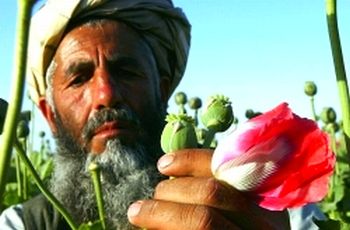 Opium has not always been a mainstay crop in Afghanistan Photo: DoD |
(TOKYO) - A United Nations study of opium production in Afghanistan released today has concluded that this year’s cultivation levels remain shockingly high, and will be broadly similar to or slightly lower than last year’s record harvest of 192,000 hectares.
Presenting the assessment, the Executive Director of the UN Office on Drugs and Crime (UNODC), Antonio Maria Costa, said that while the level of opium cultivated may have peaked, the money generated by Afghan drugs remained a destabilizing force. He warned Europe, Russia and countries along Afghan heroin routes to "brace themselves again for major health and security consequences."
UNODC’s Afghanistan Opium Winter Assessment reports a growing divide between opium-free provinces in the north-east, and ever-higher levels of cultivation in the south-west, where the Taliban insurgency is strongest. A dozen provinces are expected to remain free of opium cultivation this year, while more than three-quarters of Afghanistan’s opium is grown in areas outside the Government’s control. The assessment is based on field visits and interviews with village leaders.
"Afghanistan is becoming a divided country, with clear drugs and insurgency battle lines," Mr. Costa warned. "Opium is a massive source of revenue for the Taliban." He said this money came from a tax of around 10 per cent on opium farmers, which generated close to $100 million, in addition to money made by running heroin labs and drug exports.
The report also shows that Afghanistan has become the world’s biggest supplier of cannabis (estimated at 70,000 hectares this year), which is exported mainly through the southern borders, Pakistan and Iran to the Gulf countries.
The UN drugs chief urged Afghanistan and its allies to take decisive action. "While analysts debate endlessly how to prioritize security, development, counter-narcotics and good governance, the Afghan opium situation is becoming desperate. And time is not on the right side," he warned.
He underlined the need for strong and honest institutions to combat opium cultivation, and pointed to elements still lacking, which he said included "honest and functioning Ministries of Counter-Narcotics and of the Interior; an anti-corruption authority with integrity and credible powers; an efficient judicial system; and honest and committed governors throughout the country."
Articles for February 5, 2008 | Articles for February 6, 2008 | Articles for February 7, 2008
Quick Links
DINING
Willamette UniversityGoudy Commons Cafe
Dine on the Queen
Willamette Queen Sternwheeler
MUST SEE SALEM
Oregon Capitol ToursCapitol History Gateway
Willamette River Ride
Willamette Queen Sternwheeler
Historic Home Tours:
Deepwood Museum
The Bush House
Gaiety Hollow Garden
AUCTIONS - APPRAISALS
Auction Masters & AppraisalsCONSTRUCTION SERVICES
Roofing and ContractingSheridan, Ore.
ONLINE SHOPPING
Special Occasion DressesAdvertise with Salem-News
Contact:AdSales@Salem-News.com


Salem-News.com:


Terms of Service | Privacy Policy
All comments and messages are approved by people and self promotional links or unacceptable comments are denied.
[Return to Top]
©2026 Salem-News.com. All opinions expressed in this article are those of the author and do not necessarily reflect those of Salem-News.com.