
Publisher:
Bonnie King
CONTACT:
Newsroom@Salem-news.com
Advertising:
Adsales@Salem-news.com

~Truth~
~Justice~
~Peace~
TJP
Jan-06-2010 13:38

 TweetFollow @OregonNews
Early Modern Theories of the Imagination and the Work of Art
Salem-News.comAn explanation of what was at stake for artists like Leonardo, Michelangelo, Albrecht Dürer and Jacques de Gheyn II in the creation of fictive realities such as dragons and chimera.
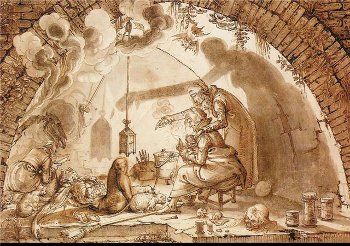 Jacques de Gheyn II, Witches in a Cellar. Oxford, Ashmolean Museum. Willamette University |
(SALEM, Ore.) - Distinguished art historian Claudia Swan will deliver the Hogue-Sponenburgh Art Lecture Wednesday, Jan. 27, at 7:30 p.m. in Ford Hall, Room 122, at Willamette University.
Swan‘s topic is “Conceptions, Chimeras, Counterfeits: Early Modern Theories of the Imagination and the Work of Art.” She will discuss influential Renaissance theories on imagination in relation to the concrete practice of art between the 16th and 17th centuries. Admission is free.
In a celebrated passage from one of his notebooks, Leonardo da Vinci offered a paradoxical recipe for making a real chimera: “If you wish to make your imaginary animal seem natural — let us say it was a dragon — take for the head that of a mastiff or hound, for the eyes those of a cat, for its ears those of a porcupine, for its nose that of a greyhound, with the eyebrows of a lion, the temples of an old cock, and the neck of a water tortoise.”
Swan will explore this trend in the praxis and theory of early modern art as a chapter in the history of the imagination, in order to understand what was at stake for artists like Leonardo, Michelangelo, Albrecht Dürer and Jacques de Gheyn II in the creation of fictive realities such as dragons and chimera.
Swan is chair of the department of art history at Northwestern University, where she is also the founding director of the Program in the Study of Imagination. She earned a PhD in art history from Columbia University, and her thesis focused on Gheyn and the representation of the natural world in the Netherlands around 1600. This research was published as a book, Art, Science and Witchcraft in Early Modern Holland: Jacques de Gheyn II (1565-1629).
The Hogue-Sponenburgh art lectureship, established and endowed by the late Janeth Hogue-Sponenburgh and Mark Sponenburgh, enables the Willamette department of art and art history to bring a noted scholar, artist, critic, curator or art leader to campus each year to deliver a lecture and to meet informally with students and faculty.
Conceptions, Chimeras, Counterfeits: Early Modern Theories of the Imagination and the Work of Art
Articles for January 5, 2010 | Articles for January 6, 2010 | Articles for January 7, 2010




googlec507860f6901db00.html
Terms of Service | Privacy Policy
All comments and messages are approved by people and self promotional links or unacceptable comments are denied.
[Return to Top]
©2026 Salem-News.com. All opinions expressed in this article are those of the author and do not necessarily reflect those of Salem-News.com.