
Publisher:
Bonnie King
CONTACT:
Newsroom@Salem-news.com
Advertising:
Adsales@Salem-news.com

~Truth~
~Justice~
~Peace~
TJP
Jun-07-2010 03:36

 TweetFollow @OregonNews
Environment News: Mass Slaughter of Marine Mammals Considered
Salem-News.comControversies over sea lion populations have erupted at different places along the Baja California Peninsula in recent years.
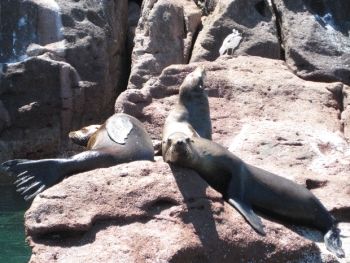 Sea lions on the southern end of the Baja California Peninsula like this, could soon be on a hit list. Courtesy: mardecortesbaja.com |
(LAS CRUCES, N.M.) - Arguably, it hasn’t been the easiest time for sea lions on the Pacific Coast of the United States and Mexico. In Washington state’s Puget Sound, several animals have been shot to death in recent months.
Last winter, the large sea lion population that usually dazzles tourists at San Francisco’s famed Pier 39 suddenly high-tailed it out the bay, only to gradually return in reduced numbers months later.
On the southern tip of Mexico’s Baja California Peninsula, fishermen are proposing a mass slaughter of the creatures because of competition over fish resources.
However, a Mexican environmental official contended the current sea lion population does not justify a slaughter.
Benito Bermudez Almada, director of the Baja California Sur office of the National Commission of Protected Areas, said sea lion numbers have actually dropped in Baja California Sur from 70,000 animals in 1978 to 30,000 in 2010.
“A huge massacre does not resolve the problem because the big sea lion colonies have diminished, such as in the case of Margarita Island where there 4,000 animals and now there are 1,200,” Bermudez added.
Nonetheless, fishermen are lobbying Baja California Sur’s state legislature to take action against sea lions. State lawmaker Natividad Osuna Aguilar said a study is being prepared to examine the legal and socio-economic aspects of the sea lion situation.
Although the sea lion is a protected species in Mexico, a “harvest” could be approved if it is determined that the marine mammals are detrimental to the local fishing industry, said Marco Antonio Gonzalez Vizcarra, director of the federal Secretariat of the Environment and Natural Resources in Baja California Sur.
In recent years, controversies over sea lion populations have erupted at different places along the Baja California Peninsula. As in the United States, numerous illegal shootings of sea lions have been reported. An important part of the food chain, sea lions are a source of food for the great white shark, whose worldwide numbers are facing serious reductions.
Frontera NorteSur (FNS): on-line, U.S.-Mexico border news Center for Latin American and Border Studies New Mexico State University Las Cruces, New Mexico
Sources:
- La Jornada, June 5, 2010. Article by Raymundo Leon. San Francisco Chronicle, May 22, 2010. Article by Carolyn Jones.
- KOMO News (Seattle), March 10, 2010. Article by Denise Whitaker and staff.
- Guardian (UK), February 19, 2010. Article by Ian Sample.
Articles for June 6, 2010 | Articles for June 7, 2010 | Articles for June 8, 2010

Quick Links
DINING
Willamette UniversityGoudy Commons Cafe
Dine on the Queen
Willamette Queen Sternwheeler
MUST SEE SALEM
Oregon Capitol ToursCapitol History Gateway
Willamette River Ride
Willamette Queen Sternwheeler
Historic Home Tours:
Deepwood Museum
The Bush House
Gaiety Hollow Garden
AUCTIONS - APPRAISALS
Auction Masters & AppraisalsCONSTRUCTION SERVICES
Roofing and ContractingSheridan, Ore.
ONLINE SHOPPING
Special Occasion DressesAdvertise with Salem-News
Contact:AdSales@Salem-News.com

Salem-News.com:

googlec507860f6901db00.html
Terms of Service | Privacy Policy
All comments and messages are approved by people and self promotional links or unacceptable comments are denied.
jimmy June 7, 2010 9:04 am (Pacific time)
Am I the only one that thinks that this is long overdue? Protect a predator of a commercial fishery and what do these "experts" think will happen? Well this "expert" can tell you that with the populations will explode. Can I have a government job as a fishery "expert" now?
[Return to Top]©2026 Salem-News.com. All opinions expressed in this article are those of the author and do not necessarily reflect those of Salem-News.com.