
Publisher:
Bonnie King
CONTACT:
Newsroom@Salem-news.com
Advertising:
Adsales@Salem-news.com

~Truth~
~Justice~
~Peace~
TJP
May-18-2009 18:45

 TweetFollow @OregonNews
Child Leukemia Rates Increase Near U.S. Nuclear Power Plants
Salem-News.comThe carcinogenic effects of radiation exposure are most severe among infants and children.
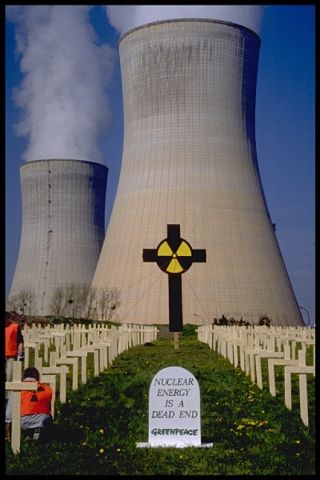 A protest against nuclear power carried out by Greenpeace International. Courtesy: macalester.edu |
(NEW YORK) - Leukemia death rates in U.S. children near nuclear reactors rose sharply (vs. the national trend) in the past two decades, according to a recent study.
The greatest mortality increases occurred near the oldest nuclear plants, while declines were observed near plants that closed permanently in the 1980s and 1990s. The study was published in the most recent issue of the European Journal of Cancer Care.
The study updates an analysis conducted in the late 1980s by the National Cancer Institute (NCI). That analysis, mandated by Senator Edward M. Kennedy (D-MA), is the only attempt federal officials have made to examine cancer rates near U.S. nuclear plants.
U.S. Rep. Edward J. Markey (D-MA), a senior member of the House Energy and Commerce Committee, said
"Nothing is more important to American families than the health of their children. It is critical that we continue to improve our understanding of the causes of child leukemia and learn how this heartbreaking disease be prevented, therefore this study deserves critical consideration."
Actor and advocate Alec Baldwin said:
"exposure to ambient levels of radiation near nuclear reactors used by public utilities has long been suspected as a significant contributor to various cancers and other diseases." Baldwin, who has a long-standing interest in radiation health issues, adds "nuclear power is not the clean, efficient energy panacea to which we are presently being reintroduced. It is dirty, poses serious security threats to our country, and is ridiculously expensive. Nukes are still a military technology forced on the American public with a dressed up civilian application."
Study authors were epidemiologist Joseph Mangano MPH MBA, Director of the Radiation and Public Health Project and toxicologist Janette Sherman MD of the Environmental Institute at Western Michigan University. They analyzed leukemia deaths in children age 0-19 in the 67 counties near 51 nuclear power plants starting 1957-1981 (the same counties in the NCI study). About 25 million people live in these 67 counties, and the 51 plants represent nearly half of the U.S. total).
Using mortality statistics from the U.S. Centers for Disease Control and Prevention, Mangano and Sherman found that in 1985-2004, the change in local child leukemia mortality (vs. the U.S.) compared to the earliest years of reactor operations were:
* An increase of 13.9% near nuclear plants started 1957-1970 (oldest plants)
* An increase of 9.4% near nuclear plants started 1971-1981 (newer plants)
* A decrease of 5.5% near nuclear plants started 1957-1981 and later shut down
The 13.9% rise near the older plants suggests a potential effect of greater radioactive contamination near aging reactors, while the 5.5% decline near closed reactors suggests a link between less contamination and lower leukemia rates. The large number of child leukemia deaths in the study (1292) makes many of the results statistically significant.
The Mangano/Sherman report follows a 2007 meta-analysis also published in the European Journal of Cancer Care by researchers from the Medical University of South Carolina. That report reviewed 17 medical journal articles on child leukemia rates near reactors, and found that all 17 detected elevated rates. A January 2008 European Journal of Cancer article that found high rates of child leukemia near German reactors from 1980-2003 is believed to be the largest study on the topic (1592 leukemia cases).
The carcinogenic effects of radiation exposure are most severe among infants and children. Leukemia is the type of childhood cancer most closely associated with exposures to toxic agents such as radiation, and has been most frequently studied by scientists. In the U.S., childhood leukemia incidence has risen 28.7% from 1975-2004 according to CDC data, suggesting that more detailed studies on causes are warranted.
The Radiation and Public Health Project is a non profit group of health professionals and scientists based in New York that studies health risks from radioactive exposures to nuclear reactors and weapons tests. RPHP members have published 23 medical journal articles on the topic. A copy of the child leukemia article is availale online by clicking here.
Source: Atheo News
Articles for May 17, 2009 | Articles for May 18, 2009 | Articles for May 19, 2009

Salem-News.com:




Terms of Service | Privacy Policy
All comments and messages are approved by people and self promotional links or unacceptable comments are denied.
heatherleerice March 12, 2011 8:50 pm (Pacific time)
I think the owners of all the nuclear power plants should move their families near the power plant and raise their children. Okay the "workers" wear protective gear. They are not exposed and I am sure the ventilation system is of the very highest quality. I am sure they ventilate outside with Filters. Yeah I am not thinking I would want to live in a cancer cluster. I think if people were more creative and stopped dwelling on negative things and started coming up with ideas there would be a way to create a synthetic fuel or new technology Please. We love trying to play God. We are intellegent we just need to tap into it. We are in a smog with very little individuality. Would you live in a cancer cluster? NO! Me either. The EAP does regulate the amounts going into the atmosphere but where are they getting their proof that it is safe? I would think clusters is the proof and the government is in denial. They allow benzene, agent orange, and thousands of chemicals to be placed in our atmosphere. Known to cause cancers and death. If you want change there has to be a back up plan. What is the solution? The government does not care if a neighborhood has a large amount of cancers. They have them in Houston and there are NO nuclear power plants. POLLUTION!!! EAP is resposible! They allow the credits to be traded and bought. So instead of the eap recommended 1 credit of poison they now let off double the poison. What a shame. I'M ALL FOR CHANGE!
Joe Montes April 14, 2010 10:54 am (Pacific time)
It is hilarious. Most of the bloggers here overlook some essential thinking processes. First of all, even though Alec is anti-nuke, it doesn't make the opposite of what is being said here true. That is a fallacy based on ad hominem. Second of all, simply measuring ambient radiation is a simplistic answer. The bloogers should shake their prejudices to think clearly. It is easy to suppose that accidental and intermittent releases of radioactive materials from the plants or vehicles to and from could be the culprit. This would probably not show up in limited testing for ambient radiation over a finite, specified time. Finally, most scientific studies are backed by statistical measures; the absence of statistics may be only illusory, as a news reporter may not refer to them in his story. So stop your childish nonsense and use your intelligence!!!! Be open minded. You could be right, but not necessarily.
NUK WRKR May 28, 2009 10:58 am (Pacific time)
Shouldn't all of the people who work at the plants be dead by now??
Mike May 27, 2009 12:55 pm (Pacific time)
Well first off, i just wanna say that it's easy to say the the effects of radiation are more harmful on children. That's just stating the facts. Have these "scientists" gone out and taken radiation reading in any of these counties?? without that, they have no basis for this leap for a connection. Do they realize that simply stepping outside of the opening to the room where the actual reactor is, reduces the radiation dose rate to ZERO. Factor in leaving THAT building and the building that that one is in. Then driving 1 mile away to the nearest highway. It's not like plants dump toxic waste in the neighborhood dump. All spent fuel is stored inside the same area as the reactor, underwater. People need to actually do some work before writing an article, and not just throwing darts at a bunch of coincidences.
VADIM May 25, 2009 8:49 am (Pacific time)
I agree with Neil and here is more info on radiation hormesis http://radiationhormesis.com
Gerald Cherry May 19, 2009 5:28 pm (Pacific time)
With so many medical journals out there, I suppose, like other scientific areas, you can get just about anything published if you go to the right place. This study is a horribly designed (and I use that term loosely) example of how not to obtain evidence for some theory, the theory at issue here is the incidence of childhood leukemia (caused by many factors) as supposedly caused by environmental radiation levels surrounding nuclear plants. The issues here are so many and varied, especially the fact that the experiment's designers are obviously not objective observers, and the simple fact that with events as seldom occurring as childhood leukemia, statistics become very unruly and are virtually useless in indicating cuasality. Added to that is the fact that there apparently was nothing more in the way of criteria for these victims than that they lived "near" a nuclear plant. But for how long? And we know that arbitrary definitions of "near" and "not near" are horribly useless without solid reasoning for the definitions (and I find it incomprehensible, knowing as we do how radiation travels from its source, that anyone would accept something as primitive as "number of units distant from the plant" as a criteria for measuring radiation levels). That's pure nonsense - we all saw that during Three Mile Island when the released radiative gases travelled and could have potentially affected only one slender segment of the area surrounding the palnt. As someone before me remarked, any 7 year old budding scientist could tell these researchers that if you want to measure the radiation emitted by a nuclear plant (if any ever is emitted, other than those occasional coolant leaks, which we know are not threatening) you do the sensible and unambiguous study of simply measuring those levels. Easy, isn't it? You don't go thru this nonsensical natural experimental procedure that has little credibility to those other than prejudiced Hollywood folk. I must say that Baldwin has made an ass of himself by pretending to understand not only science, but statistics.
Kerry bradshaw May 19, 2009 4:55 pm (Pacific time)
As a lifelong scientist and statistician, I must say that studies like these give science a bad name. The incredible aspect of this study is its sheer stupidity. If there is a question about the level of radioactivity near nuclear plants and its possible effects, the very first thing one would do is to MEASURE those levels by simple radiation monitors. Duh! I note no comment from the NTC, which has been assigned the job of evaluating dangers from radiation leaks, etc. The study was performed without a scintilla of objective data about radiation levels near and far from plants, coupled with bona fide estimates of what levels are considered harmful. This study, in effect, is attempting to measure those levels by poring over the incidence of a rarely occuring event (childhood leukemia). And to make scieitific objectivity even less likely, is defining, ad hoc, what "near" and "far" from a nuclear plant mean. The fact that nuclear plants can't just be located at random should warn you that you are dealing with a selected characteristic. Natural experiments like these are subject to gross error through bias, since there are no controls, nor even rational theories as to why one might expect higher radiation levels. There are all manner of factors that are not controlled and the statistics presented, based on an event as rare as leukemia, is by no means pursuasive. I doubt very seriously that the overall percentage of increase reported would ever reach statistical significance, even if one beleved the data to be unbiased. Considering who gathered this data, I have no reason to believe that it is unbiased. It's simply too easy to manipulate results in "natural" experiments like these. No one takes them seriously without additional unbiased and theoretically coherent data. As for nuclear power being too expensive, I note that a 1100 megawatt nuclear plant built in the US would cost around $5 billion., which would therefore produce reliable power at 5 cents per kilowatthour. That is three times cheaper than the solar power that Baldwin is promoting and cheaper than the unreliable wind power (which must be duplicated). Just look at the construction costs : a windmill that can average 1/2 megawatt costs over $2 million. That's roughly $5 billion to produce the same power as the 1100 megawatt nuclear plant. But the nuclear plant will last 60 years, the windmill about a third to a half as long, amking the comparative cost of the windmill over twice or three times as much to build. And wind power is unreliable, uncontrollable. Solar power costs more than wind power. And nuclear fuel costs are trivial - less than .4 cents per kilowatthour. Baldwin is as unreliable as his favored alternative energies. But then again he also believes the EV-1 was a practical car. Baldwin is , shall we say, a brainless Hollywood actor.
Anonymous May 19, 2009 1:20 pm (Pacific time)
Leukemia is caused by a virus? I had no idea, Neil. I thought it was something else like CANCER.
jfarmer9 May 19, 2009 10:50 am (Pacific time)
Does any one want to start a fund to send Alex “Baldwinded” to the Philippines where a legislator has said they would cause mayhem to old Alex. I assume this mean kick his ass. This comment he has made about nuclear power in this article is as ridiculous as the one he made to Letterman about getting a mail order bride from the Philippians. Well I will say this for old Alex “Baldwinded” it is hard change when you have been saying the same thing your entire life. If you have always been a fear monger like “not getting any younger” Alex you will likely always be a fear monger even if the science has proven your fears erroneous. It is just like the broken down crack addict who continues to hit the pipe even after they have lost everything. jfarmer9
Jfarmer9 May 19, 2009 10:29 am (Pacific time)
Right on Neil. I really don't have much to add except for two points. First, what is the definition of “near,” one mile from the plant or ten miles? Is there more occurrences the closer you get or does the Gama energy get deposited somewhere in the middle range say around five miles. Secondly, these numbers if true are still well below the deaths that come from the most used base load energy producer coal. Via the Nuclear Renaissance jfarmer9
Devo May 19, 2009 10:29 am (Pacific time)
Hormesis. Yes, a little bit of radiation is good for you! Vacation in Chernobyl this year! Bring the kids for a health break!
jimmy May 19, 2009 8:24 am (Pacific time)
Thanks for pointing out the true facts Neil. also, leukemia can come from many sources, not just radiation. But no mention about the proven asthma attacks, cardiac problems, upper and lower respiratory problems, and emphysema from coal plants? How much better off if would we be if suddenly 20% of the energy production in the US was turned off?
Neil Craig May 19, 2009 2:57 am (Pacific time)
Firstly the general rule is that any change in relative risk of under 20% is simply to small to even look at because that is far within random variation limits. Secondly the RPHP is clearly an anti-nuclear group, funded by anti-nuclearists and with the best will in the world is going to find it difficult to look at the statistics without bias. Thirdly since as 3 conditions are mentioned and we must assume at least as many other conditions are unmentioned and the control group must be the same size none of these figures can come from a group of more than 100 - since leukemia does tend to cluster, probably as the virus that causes it is passed round, it is in no way surprising that there might be an extra 13 deaths out of 100 expected. Fourthly and most importantly there is massive evidence, that doesn't get reported, that low level radiation significantly cuts cancer - why, for example, does this clearly biased "study" get covered but the media wholly fail to report the radioactive housing blocks in Taiwan which had a 96.3% REDUCION in cancers. http://a-place-to-stand.blogspot.com/2009/05/radiation-hormesis.html
Jabber May 18, 2009 8:29 pm (Pacific time)
Oh, gee, I have been hearing that nuclear energy is "clean and green." After all, it doesn't emit greenhouse gasses. Are you sure radioactivity can make children sick? I thought nuclear power was a good thing. . . that's what they keep saying in those ads from the utility companies that build nuclear plants.
[Return to Top]©2026 Salem-News.com. All opinions expressed in this article are those of the author and do not necessarily reflect those of Salem-News.com.