
Publisher:
Bonnie King
CONTACT:
Newsroom@Salem-news.com
Advertising:
Adsales@Salem-news.com

~Truth~
~Justice~
~Peace~
TJP
Dec-17-2009 01:52

 TweetFollow @OregonNews
Salute to My WWII Dogface Buddies: a Hoorah 65 Years Late
Dr. Phil Leveque Salem-News.comIt took me about 20 years before I could think about or talk about WWII. Many of my fellow Dogfaces still can’t.
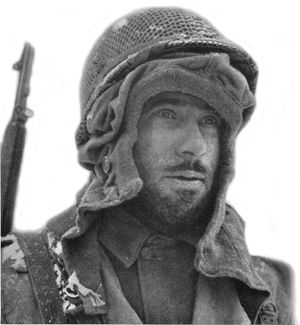
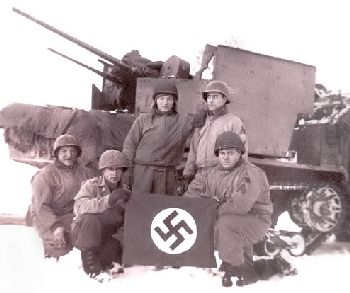 Scenes from the Battle of the Bulge in WWII |
(MOLALLA, Ore.) - This time of the year around Veteran’s Day and the Anniversary of the Battle of the Bulge, we 'Dogface' Infantry Veterans of WWII in Europe pause in thankful reflection of the nearly unbearable sacrifices of our fellow soldiers in that battle.
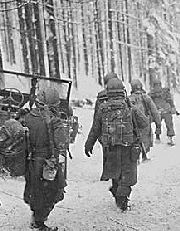
20,000 young American boys, mostly under 20 years old, died and 80,000 more were wounded or captured because of some incredible blunders up the line of command at Regiment, Division, Corps and Army headquarters who had been advised of suspicious activity at the front, which they ignored.
The Two Divisions which were on the extreme front were the 106th (The Hungry and Sick, as they called themselves) had just arrived at the front. The other was the 28th (Bloody Bucket, as they called themselves).
The 28th had been nearly destroyed in the month before in the Huertgen Forest and was put in an erstwhile quiet, rest area to be re-equipped and re-supplied with green replacements mostly fresh from the States.
Neither Division could have been considered ready for battle. The American Generals KNEW this but so did the German Generals.
The Americans had suffered from several tactical and strategic blunders before, and the frontline troops knew that they would be miraculously lucky if they got home alive.
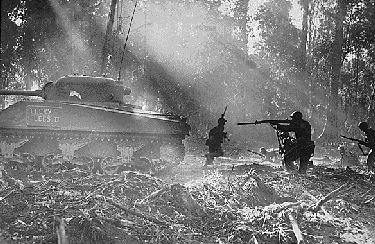
A million dollar wound which would get one out of combat was a fervent prayer, and possibly thousands either shot themselves or exposed themselves to enemy fire or the severe cold just to get out of a deadly no-win, no-hope situation.
The frontline combat forces could see that if an officer got even a slight wound or “battle-fatigue”, that officer was usually sent way back or home never to be seen again.
If a Dogface “broke down” he was given heavy sedation for 2 or 3 days and usually sent back to the front. About one-fourth of battle casualties were said to be “battle fatigue”.
General Patton didn’t believe in “battle fatigue” but he slept in a warm bed every night, had warm meals and NEVER got cold, wet, dirty, shot at or scared beyond his wits.
The Dogface Infantry, who were only about 10% of the armed forces, were usually cold, wet, dirty, hungry, dead tired, and scared out of their wits.
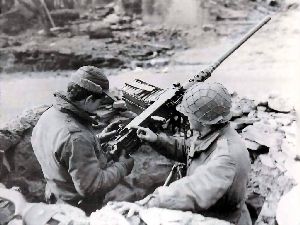
There was usually no surcease and little support because the rear echelon S.O.B.’s were stealing food, warm clothes, blankets, overshoes, etc and keeping it for themselves or trading it on the black market for wine, women or money. The officers didn’t care much because they WERE supplied.
The frontline scouts reported enemy tank and troop movement several days before Battle of the Bulge attack started. An Army scout can detect German tank track noise in his sleep. Nobody paid any attention.
Even Generals Eisenhower and Bradley were eating oysters and drinking champagne in Paris, 200 miles away, when it became evident that a big battle was on its way. General Montgomery was playing golf.
The 106th Division slowed down the German Panzer Army but about 20,000 were captured, killed or wounded and the Division ceased to exist.
The 28th Division, especially the 110th Regiment, was out- numbered about 10 to 1 but still held up the German advance for two days to give the 101st Airborne time to get to Bastogne and dig in.
If the 28th hadn’t held while being itself destroyed, there would have been no “Battle of Bastogne” and the total battle would have been much worse than it was.
I was in the 89th Division. The 106th barely beat us to the front – lucky us. We lost our men in The Rhineland and crossing Germany towards Dresden.
Other Divisions had high casualties but none as bad as the 106th and 28th.
In the Battle of the Bulge the 101st Division, because they were dug in in defensive positions at Bastogne, had only 1641 casualties. Other defenders: the 10th Armored had 503, the 9th Armored somewhat more. The remaining defenders suffered 1400.
The British had a total of 1400 casualties with 200 dead.
For the Germans it was much worse. They started with at least 500,000 men. About 100,000 were killed, wounded or captured, but the rest escaped back to Germany where we had to fight them again in The Rhineland, The Ruhr Pocket and Central Germany.
It took me about 20 years before I could think about or talk about WWII. Many of my fellow soldiers still can’t. We know what Post-Traumatic Stress Disorder is and we still get the shakes.
I’m relieved that I’m finally getting over most of it and it is my moral obligation to the 200,000 WWII Infantry Vets who died for me to tell at least a part of their heroic history.
 |
Articles for December 16, 2009 | Articles for December 17, 2009 | Articles for December 18, 2009

Quick Links
DINING
Willamette UniversityGoudy Commons Cafe
Dine on the Queen
Willamette Queen Sternwheeler
MUST SEE SALEM
Oregon Capitol ToursCapitol History Gateway
Willamette River Ride
Willamette Queen Sternwheeler
Historic Home Tours:
Deepwood Museum
The Bush House
Gaiety Hollow Garden
AUCTIONS - APPRAISALS
Auction Masters & AppraisalsCONSTRUCTION SERVICES
Roofing and ContractingSheridan, Ore.
ONLINE SHOPPING
Special Occasion DressesAdvertise with Salem-News
Contact:AdSales@Salem-News.com

Salem-News.com:

Terms of Service | Privacy Policy
All comments and messages are approved by people and self promotional links or unacceptable comments are denied.
Anonymous November 12, 2015 4:28 pm (Pacific time)
The dogface soldiers lost 40,000 just in their unit, the 3rd Infantry, between Casablanca Nov 9 1942 and Anzio, Feb 1944. They lost all at the Canal. the "suicide" mission it was later called. Upon regrouping, since no divisions of that caliber any longer existed, All Fresh Troops were brought in, in preparation of the Normandy invasion, all the way to Berlin, the route Dr. Leveque travelled here, the European final front...My father never again faced combat after recovering in Naples, eventually back to the states after being debriefed, he survived, you know. I think he was the only one, seems that way, when he finally spoke about it some 30 years or so later. Never forget what these vets have done for us. Thank you Dr. Leveque for sharing this other "leg" of the story here. I have a letter from the doctor that treated my Dad in Naples...the VA they lost it in the fire in St. Louis...Dad passed in 2008, I'm still trying to secure his CIB and his other purple heart, I have his photocopies here of the doctor's statement and the list of men treated. It's says at the top US British Confidential, I don't know why they wouldn't deliver his medals when the proof was brought to the table in '88. Strange, huh? I think it's the losses that angered the Army, as we failed so miserably at Anzio...
Dr. Leveque December 17, 2009 2:19 pm (Pacific time)
Received via email from James D. West: I think you need to revisit your facts concerning the 106th Division in the Battle of the Bulge. I can spot many glaring errors.
First, if they lost 20,000 as you state, there would not be any division left. But in the months to follow, they were reorganized and guarded thousands of German POWs.
Their Association still exists and all these FACTS can be read at www.IndianaMiliatry.org
MY RESPONSE: James, The Hungry and Sick on the mountain with 2 Regts and everything else for 2 RCTs. They lost EVERYTHING. I met many Golden Lions after the war. They were never again in Division Combat. They DID guard POWs. They had almost NO Heavy Equipment left. Thanks for your letter.
Phil Dogface Leveque
89th Division
jimmy December 17, 2009 9:58 am (Pacific time)
I can read this article, thank you to all my teachers. I can read this article in English, thanks to Dr. Leveque and his fellow Vetrans. TAKE THE TIME, THANK A VET!
[Return to Top]©2026 Salem-News.com. All opinions expressed in this article are those of the author and do not necessarily reflect those of Salem-News.com.